Showing posts with label photo. Show all posts

Monday, January 3, 2011

Picture This Photo Contest – January 2011

As we kick off the New Year, what better way to start off our first Picture This Photo Contest of 2011 then with David Perry as our judge. As many of you may remember from our August 2009 Picture This, David is a phenomenal, multi-faceted photographer whose work is inspirational.? His website and blog, A Photographer’s Garden Blog are both feasts for the eye and a testament to David’s depth, creativity, and talent as both a garden photographer and writer.

20101027_ps[1]-David Perry-opening photo “Ok, my point-and-shoot-camera-lovin’ friends, you’ve all heard of time in a bottle and a tempest in a teapot, but (unless you’ve been following my blog, A Photographer’s Garden Blog at least November of last year, I’d be willing to bet you’ve never heard of “Macro in a Mason Jar” until now. And that is the theme for this month’s “Picture This” photo contest: Macro in a Mason Jar. Unlike some assignments where the kids with the bigger, fancier cameras have a distinct advantage, I’ve designed this contest just for you, point-and-shooters, but you will need to think small and get close, and you will need to find that nifty little close-up button on your camera, the one that looks like a flower symbol.

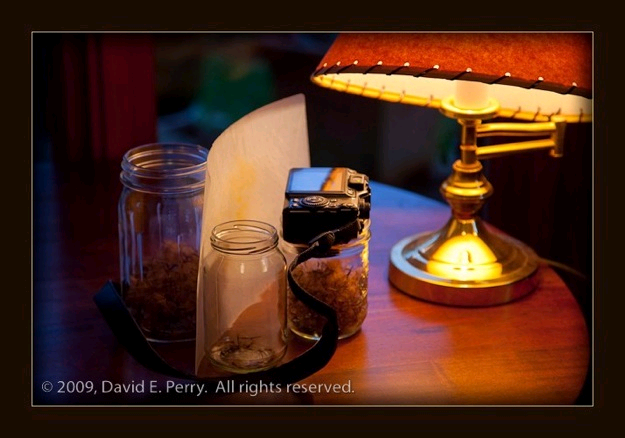
David Perry-a table lamp and small jar So here’s the dealio. This is a technique so simple, that anyone, even nervous types with coffee jitters, can get razor-sharp close ups of beautifully lit subjects without a tripod, and have a really good time doing it. Follow along with me for a minute while I show you what I mean. Then you can fire up your cameras, round up your repurposed jam, mayonnaise and peanut butter jars and start making a new kind of macro-photo magic.

What you’ll need:

1: A point and shoot camera with close-up capabilities or an SLR camera with a macro lens, or extension tubes. (Point-and-Shooters, look for the little flower symbol on a button or dial on the top of or back of your camera, and press it to turn on the close-up feature. Many little digital cameras will focus down as close as a half inch from the subject.)

2: A Mason jar, a peanut butter jar, a mayonnaise jar, a jam jar, a pickle jar . . . or all of the aforementioned.

David Perry-a side view of table lamp and jar

3: A willingness to play both with the subject you put in the jar, but also with the direction, quality and hue of the light pouring into the jar.

And here (below), are some of the exquisitely simple types of shots that you can get by shooting straight down into jars just like these. These are great practice type shots to help you get warmed up, but I’d encourage you, once you’ve got the hang of making shots like these, to try to shoot even more complex shots visually. Pictures with mystery and story.
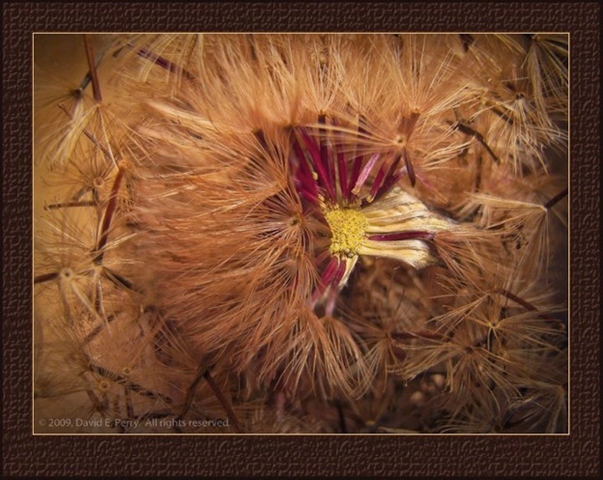
David Perry-shot made from table and lamp set up

Now, for a quick primer on technique:

Once you’ve made any desired adjustments and framed up your shot, press your camera body downward, onto the rim of the glass jar while you depress the shutter button. The rigidity of the glass will keep the camera precisely distant, relative to the subject during your exposure, meaning that your pictures should be extra crispy sharp.

You can also add a plastic cutting sheet (as I have below), or enlist the white envelope that that latest piece of junk mail came in to serve as a reflector, softening the shadows by placing it either behind or beside the Mason jar to bounce light back into the image from another angle. Or, if you decide you need to diffuse the light from your table lamp or the window to soften the shadows, place the diffuse cutting board between the light source and the jar. You’ll be able to see the effects right away in the screen.

DavidPerry-quick primer on technique

I’d also encourage you to try to create and use “weird” light. Try shining a lamp through another jar filled with ice tea, or ice cubes and water and lemon slices right next to your shooting jar. Or bounce light off of a makeup mirror and into your shooting jar, or spritz the outside of your jar with a spray bottle, or use the want ads from the newspaper beneath the jar and wrapped around it. See how those elements can add background and shadows and other interest to the scene you’re shooting.

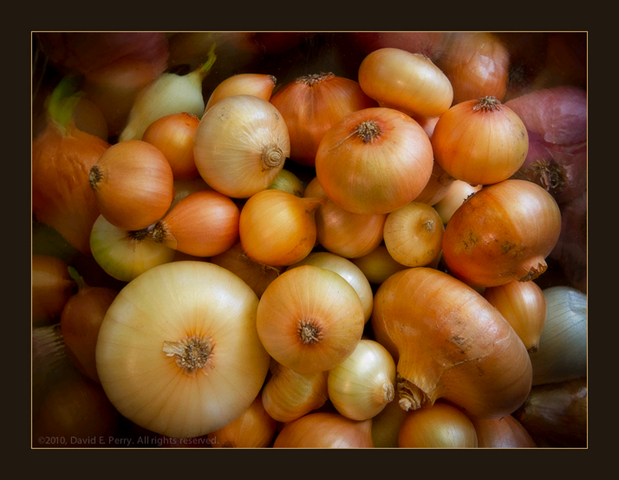
Notice the yellow plastic cutting board that I’m holding above the jar to color the light and give the scene an even warmer glow.

And here’s what the camera recorded. David Perry-onions-Micro In A Mason Jar
Here’s another example. An oyster on the half shell, a bit of hot sauce, and a bed of rock salt.
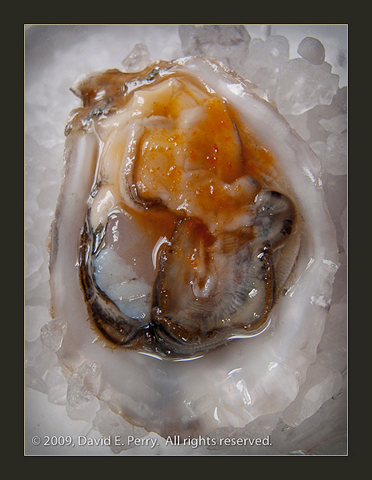
oyster on a hot shell-David Perry

Backing away a bit, now you can see the simplicity of the setup I used to get the shot. Note the rock salt on the outside of the jar, as well, and that I set the shot up on a white plate to help give the entire shot that high key, icy look.
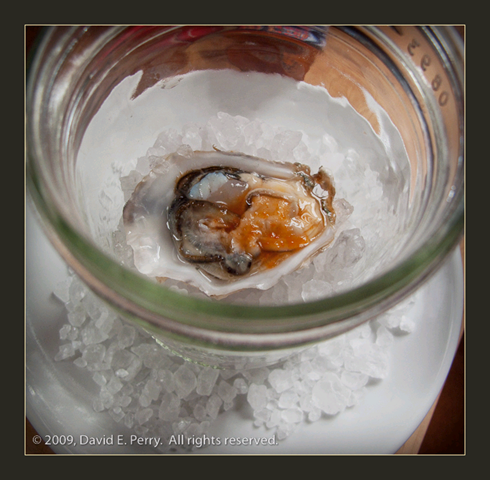
David Perry-oyster on a hot shell from a distance

So, this month, I’m asking you to think small and get in close . . . to show me some essential aspect of a subject that simply cannot be seen or appreciated from a distance. The point of this contest is to encourage you to look and see from new perspectives, to learn more about your camera’s amazing capabilities. For your entries I want to see pictures that take me into the depths of a subject and that leave me feeling that I’ve seen something in a completely new way. I want to see pictures that record the play of light and shadow, and texture, and that set the table for an intriguing story while looking downward into a glass jar.

Your pictures can be of nearly any subjects for this contest, but I really want photographs that allow me to see seeds, feathers, plants, flowers, insects or textures in ways that are fresh and unexpected. The images should be about seeing first and the subjects second. They need to evoke mood, and they should strive to elicit some sort of emotional, poetic, or “Wow!” response.

Here (below), I shot to the edge of the jar, instead of trying to avoid it. Note the dry grass outside the jar. After shooting this one, I made a mirror image of it in Photoshop, merged the two and then made a typographic wordplay on the “self-sealing” words that had been cast into the glass during the manufacturing process.
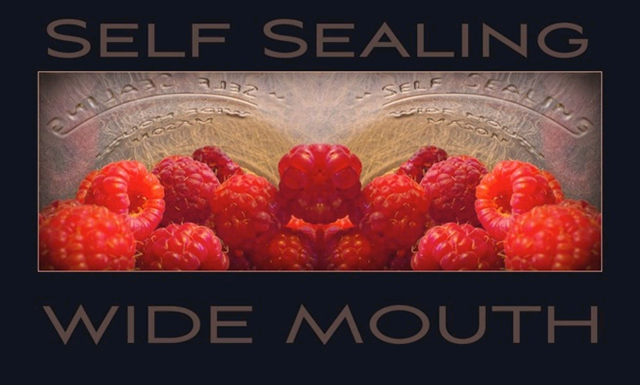
David Perry-edge of jar with raspberries

Consider shooting through the bottom of a jar and into a mirror for an unusual self-portrait.
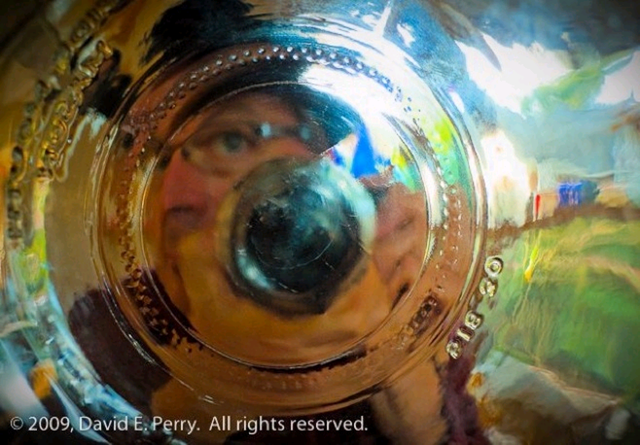
David Perry-bottom of jar shooting through the mirror

?

?

?

?

?

?

?

?

?RULES FOR ENTERING THE CONTEST

1.? You must have an active blog in order to participate. To be eligible for judging, you need to leave us TWO links – a direct link to the image, and a link to your blog post that includes the image – in a comment on this post.

2. Your photo must be able to be copied from your site. That makes it possible for us to collect all the entries in one place for easier judging.

3. The deadline for entries is 11:59 PM Eastern time on Monday, January 24, 2011.

Entries that meet the above rules will be added to a separate gallery page. If you enter but your photo does not appear in the gallery within 24 hours, please review your entry to make sure you followed the rules.

All photos courtesy of David Perry.

This entry passed through the Full-Text RSS service — if this is your content and you're reading it on someone else's site, please read our FAQ page at fivefilters.org/content-only/faq.php
Five Filters featured site: So, Why is Wikileaks a Good Thing Again?.

View the original article here

Monday, November 1, 2010

The Photo Workshop

garden photography students

I have really been having fun learning how to run the garden photography workshops at San Francisco Botanical Garden.? Each class has become a lesson on one particular theme.

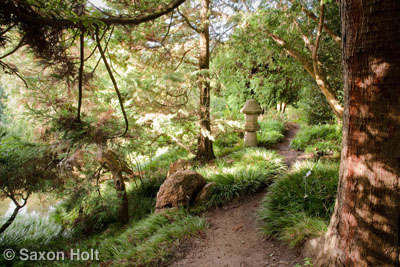
You too can learn, by giving yourself an assignment, something to work on – and just do it.? For instance “focal points”.? Here, at SFBG we are using the Japanese lanterns as an element, a focal point to draw the eye into the composition.

japanese lantern focal point

When considering a photo it can be really helpful to find some element that will help the viewer focus on the the image and consider what story you are trying to tell.? It does not necessarily need to be an object, it can be a bold plant for instance, but something in the photo needs to be the key to understanding it.

Hand in hand with focal points comes “framing”, another lesson we use.? I actually stumbled onto that lesson as I watched the students (in the first photo), and noted the tree was a key element in helping to define the focal point.

Consider this next scene in the South African collection at San Francisco Botanical Garden.

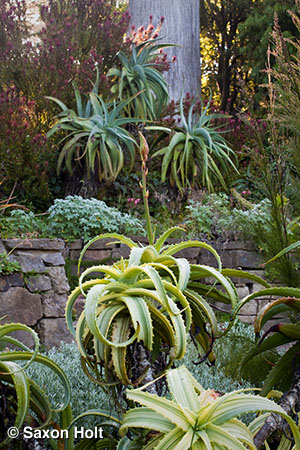
aloe wide view

The bold, variegated aloe that is just beginning to put up its winter flower is an obvious attention grabber.? But too often we are struck by the exciting potential of a garden photo but compose too loosely.? Here, the focal point is not well framed; and there is a tree sticking out of the top of the photograph.

Consider for a moment what the story is, and make all elements of the composition work for you.

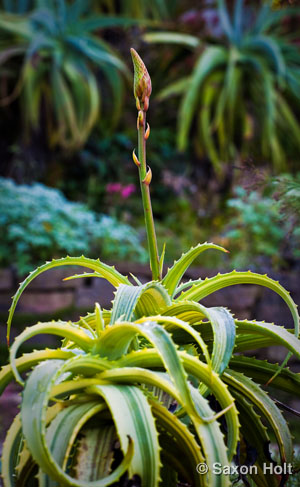
aloe framed by other plants

By coming in tighter and using the background shapes to anchor the corners, the aloe is framed and the eye wants to stay in the photograph.

Another classic compositional tool is “lines”.? Often pathways and walls offer the photographer some simple tools that draw the viewer into and through the photo, connecting the elements into one frame.

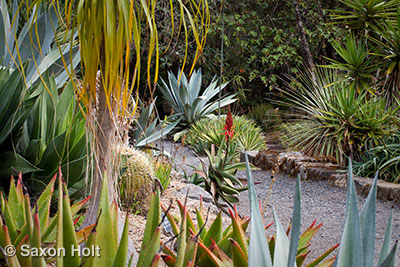
lines of pathway through the succulent garden

Here, the pathway that runs between these two sections of the succulent garden at SFBG help connect the left and right sides and pull the eye into the focal point which is the beautiful gray Agave.? Note the elements that frame the scene: the line of Agave at the bottom, the group on the left, and the little explosion of shapes in the upper right.

All these tools hold the photo together while the line pulls you into the focal point.

Used this way the lines not only draw the eye into the photo, they carry the eye across the composition.

student studying lines in the succulent garden

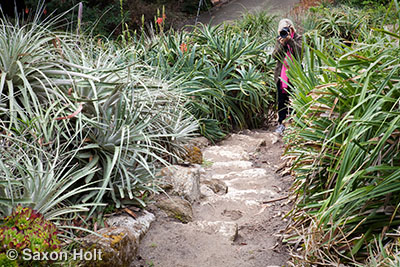
In this photo, of a student at work using the camera to frame the scene before she moves the tripod into place.? (You will use the tripod, right, Angela ?)? Note there are multiple lines.? The pathway steps lead the eye from top to bottom, while the row of bromeliads and aloe lead left to right – directly to the focal point of the photographer.

Hmmm . . . .? the wonderful hot pink spot of color in her scarf help this composition as well.? Maybe my next lesson will be on color as a composition tool.

Whether or not you can get to a workshop, there are many ways to improve your photography.? Experience is by far the best teacher and you learn by doing.? Give yourself something to work on – and go do it.

This entry passed through the Full-Text RSS service — if this is your content and you're reading it on someone else's site, please read our FAQ page at fivefilters.org/content-only/faq.php
Five Filters featured article: Beyond Hiroshima - The Non-Reporting of Falluja's Cancer Catastrophe.


View the original article here

Friday, October 29, 2010

Introduced October 2010 photo contest winners

Early August Annuals

Ready for results? Here's what this month of the judge, Craig Cramer Ellis Hollow, had it

I'm admiration.

When Nan first asked me to judge the contest this month, I was afraid that zero entreriez.serait put an end to their cameras and try this rather unorthodox technique? It was a risky idea.

But it was unnecessary to ring. We found with 14 beautiful entries, and you should go to the Gallery to soak the all in.

Honourable mentions

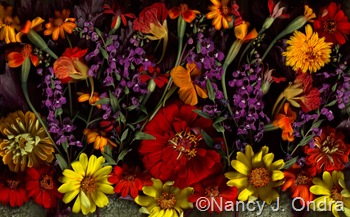
I am really like blooms Passiflora, Coleus leaves lime and purple flowering plum created by Shellene Mueller landscape leaf collage. "If you presented your plant together combos in this format for displaying your clients?", she wrote on her blog designs by Shellene. "This as an excellent way to get their enchanted by the palette you've planned for their garden, especially those which are made to the"Visual"challenge."

Designs by Shellene

Arrangement below by Gardener Braque of Austin (Texas) also caught my eye.She writes: "it is a concept to create a photographic image without a caméra.Il is also lots of fun." I had no experience with a scanner. In fact, I would even have one. I showed to my friend with a box full of cuttings's House in my garden and we began to play.We have had much time until our children begin to appeler.Apparemment must be fed on a regular basis!?

The Whimsical Gardener

It took Cherry Crest addressing several sessions to reenter the next mix. " But I am always pleased to step.As I mentioned, I'm holding to flourish?"she écrit.Vous must now, Cherry.Et I hope you caught the bug and keep scanning."

Approaching the Crest

Silver Medal

Runner this month following up comes from scanner experienced Judith Cowles over the garden worm.She and her sister create cards and calendars, decoupaged on wood or glass for the boat, or printed projects analyses on fabric and transformed into pillows or bags that they sell online.

Surprise.Judith defines a technique and cheeriness toolbar.

Gold Medal

Winner of this month is the supernova Lily 'Madam Ganna Walska', the purple heart and jewellery Opar Philip at East Side Patch coming .Son planets is distinguished by its cosmic creativity, evoking the appearances that transcend the flowers on the bed scanner. "Who would have thought that you could have so much fun with a scanner, apart from the mandatory Office pranks?"I couldn't agree with you more Philip.

It's second "Picture This" Philip.Il gold medal also won the theme August 2009 down on your knees.

Thanks again to everyone who braved the new technology to enter if you don't get to scanning attempt, I hope that you'll now inspired faire.Tomber me a comment to the Creux de Ellis so that I can come take a look.

This entry transmitted via the service for full-text RSS - if this is your content and you read on someone to another site, please read our FAQ page fivefilters.org/content-only/faq.php
Article five filters features: After Hiroshima - non-rapport Cancer Catastrophe of Fallujah.


View the original article here

Sunday, October 24, 2010

Photo workshop

garden photography students

I was really fun to learn how to run San Francisco botanical garden garden photography workshops.? Each class has become a lesson on a specific theme.

? You can also learn by giving you a posting something to work on - and just to do.For example "focal points".Ici SFBG, Japanese lanterns as an element, we use a focus to attract the eye in the composition.?

japanese lantern focal point

Review a picture can be really useful find elements that help to the attention of the Viewer on the image and examine what story you are trying to say.? It did not necessarily need to be an object, it can be for example a fat plant, but something in the photo must be the key to understanding.

Hand in hand with the focal points is "frame", another lesson that we use.? I actually stumbled on this lesson that I've watched students (first photo) and noted that the tree was a key element to help define the focal point.

Consider this next scene in the South African collection at the San Francisco botanical garden.

aloe wide view

? The bold, variegated aloe that begin its winter flower is a gripping attention évidentes.Mais too often we are struck by the exciting potential of a garden photo but deal too loose.Here, the point of contact is not well encadré.et there is a tree stand out from the upper part of photography.?

Consider a moment what the story is and all the elements of the work of composition for you.

aloe framed by other plants

By using the background shapes to anchor the corners arriving more stringent, Aloe is framed and the eye wants to stay in the photograph.

Another classical composition tool is "lines".Often track and walls offer the photographer some simple tools that draw the viewer in and through the photo linking elements in an image.

lines of pathway through the succulent garden

Here, the only way between these two sections of the succulent garden SFBG tracks to connect the left and right sides and extract the eye in the focus point is the beautiful grey agave.Note elements as part of the scene: the line of the agave, group on the left and the explosion little forms in the upper right corner.

All these tools hold together the picture while the line draw you in the focal point.

Used in this way, lines not only attract the eye in the picture, they carry the eye of the composition.

student studying lines in the succulent garden

In this photo, a student to work using the camera for the scene before it moves the tripod in place.(You going use the tripod right, Angela?)Note There are several steps lignes.Les track to eye top to bottom, while the bromeliad and lead Aloe, line from left to right - directly to the focal point of the photographer.

Hmmm.... wonderful rose against warm color in her scarf helps this composition as. perhaps my next lesson will be the color as a composition tool.

Whether or not you can access a workshop, there are several ways to improve your photographie.Expérience is by far the best teacher and you learn by the pratique.Vous something at work - and go.

This entry transmitted via the service for full-text RSS - if this is your content and you read on someone to another site, please read our FAQ page fivefilters.org/content-only/faq.php
Article five filters features: After Hiroshima - non-rapport Cancer Catastrophe of Fallujah.


View the original article here

Tuesday, October 19, 2010

Cover photo

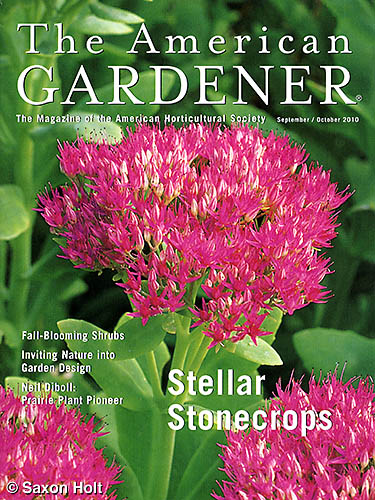
Arrival of the current edition of The American Gardener of the American Horticultural Society I immediately read on my friend Neil Diboll glory of the nursery of the prairie and seen the YouTube interview.? And then a beautiful story by Duncan Brine on naturalistic garden.? Compatriots GG Wild blogger Debra Lee Baldwin excuses, I did not much pay attention to the functionality of succulent on Stonecrops.

The American Gardener cover

But then this week I got extra copies of the magazine editor - and a check for the fees.? It is always good news;but I had not recognized my photo on the cover, Sedum spectabile "Neon" it was not a photo, I remember that send to Editor months ago when they requested photos.?

? I send lots of photos to publishers wishing to match their needs with my photos.Often, I will send scores with a hope that one or two will be selected and many times I would even see them when they are publiés.Parfois I forget that I sent.? Even though I follow-up in my database, unless it is one of my own books, I still not very involved in the process.

? This is a cold fact of life that if I take an image in your garden, it could get published one day and neither you nor I would know.? This is a big reason that I always get a written permission of the owner of a garden publish pictures until I click on the component, and yet, there may be situations.

Imagine that you are the owner proud but private end a big garden with a gardener for your household staff.? You want to share your garden, but you very sure want to international tourists attacked, gardens for you are a photographer who promises to ensure the safety of your identité.Ans later, trustworthy publication rights after your garden has been published in a magazine of gardening, your maid just be told what the garden looked in a beautiful book, she saw in the library.I have a say on this one even though I had authority and photo caption gave no indication of the location of the garden.

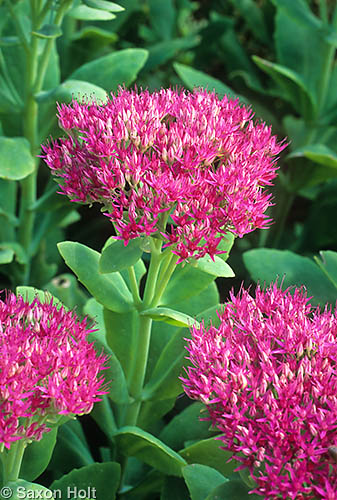
Stonecrop "Neon" on the cover of The Gardener American photo was taken a few years when I was in Denver working on my book Plants Hardy with Gwen Kelaidis YH ' shot many Sedums Denver Botanical Garden and definitely remember it:

Sedum spectabile 'Neon'

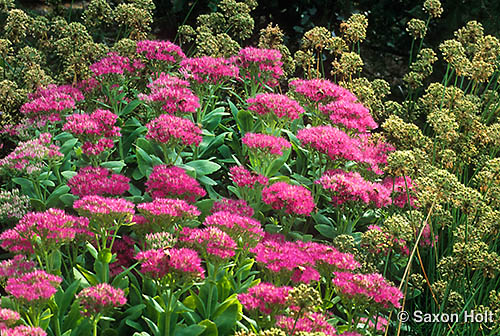
Many, I prefer to take shots of plants so that my audience gets a realistic idea of the scale plantations and companion.When I can create an effect of tapestry, filling a whole frame with like plants with Sedum mixture with some past an Allium seedheads anonymous, I remember the picture as my propre.Le tight beam of solitary flowers shot was a detail of the scene, and I remember not to take the picture.

Here is how it looked before the magazine cropped it.

Stonecrop, Sedum spectabile 'Neon'

Note they kept each millimetre that they could top type and that are cropped off the bottom so that the second and third flower anchored at the bottom of the page.Appara?t as a simple photo corners and it is, but the fact that it is clear with room type is a good choice for a cover.

I said in the previous message when I'm working a garden, I try to to do not forget to take vertical shots that could be used for a photo of the couverture.Dr?le I remember to do when taking photos, but I quickly forget that send them.

This entry transmitted via the service for full-text RSS - if this is your content and you read on someone to another site, please read our FAQ page fivefilters.org/content-only/faq.php
Article five filters features: After Hiroshima - non-rapport Cancer Catastrophe of Fallujah.


View the original article here